

Most safety programs are judged by one number: recordable incidents.
But by the time an incident is “recordable,” the damage is already done:
The future of warehouse safety — and sustainable productivity — isn’t about reacting to injuries.
It’s about predicting and preventing them.
That’s where near-miss tracking comes in.
Near misses are early warning signals.
If you learn from them, they’re free lessons.
If you ignore them, they become tomorrow’s injuries.
A near miss is an event where:
Examples:
In most facilities, these events are:
That’s a missed opportunity.
Traditionally, safety performance is tracked through:
These are important — but they’re lagging indicators. They tell you:
“The problem already hit us.”
Near-miss tracking shifts the focus to leading indicators:
Facilities that track near misses consistently:
In high-velocity operations, that’s a competitive advantage — not just a compliance checkbox.
Near-miss tracking isn’t just about injury prevention. It directly affects:
When people feel safe:
Safety isn’t “extra.”
Safety is how performance becomes sustainable.
Most facilities underutilize near-miss reporting for three reasons:
Associates don’t want to “snitch” or get in trouble.
Solution:
Make it clear that near-miss reporting is:
protected
encouraged
never used for punishment when reported in good faith
Reward reporting — don’t punish honesty.
If people don’t know how or when to report, they won’t.
Solution:
Create a simple path:
The process must be fast, simple, and widely understood.
If people report hazards and nothing changes, they stop reporting.
Solution:
Close the loop:
When associates see action, reporting becomes part of the culture.
Here’s how high-performing DCs build near-miss programs that actually work.
Make sure everyone knows:
Keep the definition simple:
“Any time something unsafe happens or almost happens — and we got lucky.”
Use:
If it takes more than 60–90 seconds, it’s too complicated.
Don’t treat near misses as isolated events.
Ask:
You’re not counting events — you’re diagnosing patterns.
Instead of:
“Be more careful.”
Ask:
Near misses are often symptoms of process issues, not just “careless people.”
Fold near-miss analysis into:
That’s how safety stops being a separate silo and becomes part of performance management.
Managed labor teams — like FHI’s model — are uniquely positioned to support near-miss programs because they:
Instead of safety being “HR’s job” or “EHS’s job,” managed labor turns it into part of hourly operational leadership.
The result:
The future of warehouse safety isn’t about new posters or slogans.
It’s about treating near misses as gold, not noise.
When you:
…you move from:
“We hope nothing happens”
to
“We see risk before it becomes harm.”
Near-miss tracking is where safety, trust, and performance finally align.
Q1: What is a near miss in a warehouse?
A near miss is any unplanned event that could have caused injury or damage but didn’t — often due to luck or last-second intervention.
Q2: Why is tracking near misses so important?
Because they reveal hidden risks before they become incidents, allowing you to fix root causes early.
Q3: Won’t near-miss reporting slow down production?
Not if the process is simple. In fact, it prevents future downtime from accidents and rework.
Q4: How do we get associates to report near misses honestly?
Make it non-punitive, simple, and show visible action and appreciation when they report.
Q5: How does managed labor support near-miss programs?
Managed labor provides on-floor leadership and structure to capture, review, and act on near-miss data as part of daily operations.
👇📅 We're here to help. There's no pitch - just a conversation. 📅👇
If you need dependable support to reinforce your team and get you back on track, FHI NOW can help.

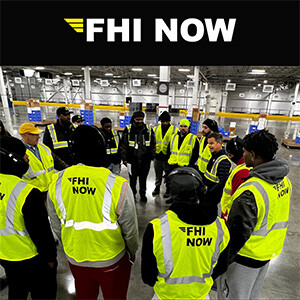
In any market, your supply chain can make or break your ability to compete well. Don't leave that to chance. We can help you create a stronger operation, so you never fall behind the competition.
Stop worrying about labor challenges and start enjoying a safe, lean, and rock-solid supply chain.
(800) 849-3132 | © FHI. All rights reserved.