

For many growing companies, warehouse and distribution operations start as a necessity—not a strategic priority. But as order volumes increase, SKUs expand, and customer expectations rise, managing a warehouse quickly becomes one of the most complex and resource-intensive parts of the business.
That’s why more organizations are turning to full 3PL warehouse management: a model that allows leadership teams to step away from day-to-day operational headaches and refocus on what truly drives growth.
Full 3PL (third-party logistics) warehouse management goes far beyond providing labor or temporary staffing. In this model, a trusted partner assumes end-to-end responsibility for warehouse operations, including:
Workforce management and supervision
Safety, compliance, and training
Productivity standards and performance metrics
Operational reporting and visibility
Continuous process improvement
Instead of managing people, schedules, safety programs, and KPIs internally, companies partner with an experienced operator that runs the warehouse on their behalf—while remaining fully aligned with their business goals.
Running a warehouse internally often works—until it doesn’t.
As businesses scale, internal teams are stretched thin by:
Recruiting and retaining reliable warehouse labor
Managing fluctuating volumes and seasonal demand
Navigating safety compliance and OSHA exposure
Maintaining productivity standards across shifts
Spending leadership time on operational issues instead of growth
What begins as a controllable function can quietly become a growth bottleneck.
Full 3PL warehouse management reframes the problem: instead of asking “How do we manage this better?”, companies ask “Should we be managing this at all?”
While every operation is different, companies often explore full 3PL management when they experience:
Rapid business growth that outpaces internal infrastructure
High employee turnover or labor instability
Inconsistent productivity or service levels
Increasing safety incidents or compliance concerns
Leadership burnout from operational firefighting
These aren’t signs of failure—they’re signals that the business has outgrown its original operating model.
A true full 3PL warehouse management partner doesn’t just supply workers. They take ownership of outcomes.
That includes:
Operational leadership: On-site management accountable for performance
Labor strategy: Recruiting, training, scheduling, and retention
Safety & compliance: Programs designed to reduce risk and protect the operation
Performance management: Defined KPIs, reporting, and accountability
Scalability: The ability to flex labor and processes as demand changes
The result is a warehouse that runs with predictability, consistency, and transparency—without consuming internal resources.
When warehouse operations are fully managed, leadership teams regain time and focus.
Instead of dealing with:
Staffing shortages
Shift coverage issues
Safety incidents
Productivity gaps
They can focus on:
Entering new markets
Launching new products
Improving customer experience
Strengthening the supply chain
Full 3PL warehouse management doesn’t remove control—it replaces day-to-day involvement with clear performance visibility and strategic oversight.
Not all 3PL providers are created equal. When evaluating a full warehouse management partner, companies should look for:
Proven experience running entire operations
A safety-first culture with measurable results
Transparent reporting and performance metrics
A partnership mindset, not a transactional one
The ability to align warehouse execution with business goals
At FHI, full 3PL warehouse management is designed to help companies operate smarter, reduce risk, and scale with confidence—so their teams can focus on growing the business instead of managing the warehouse.
Full 3PL warehouse management includes end-to-end responsibility for labor, supervision, safety, productivity, reporting, and operational performance—not just staffing.
Managed labor focuses on supplying workers, while full 3PL warehouse management includes leadership, accountability, KPIs, safety programs, and continuous improvement.
No. Many mid-sized and growing companies adopt full 3PL management when warehouse complexity begins to distract leadership from growth initiatives.
No. Companies retain strategic oversight while gaining clearer performance visibility through structured reporting and defined KPIs.
Companies typically consider full 3PL management during periods of rapid growth, labor instability, rising safety risk, or operational inefficiency.
👇📅 We're here to help. There's no pitch - just a conversation. 📅👇
If you need dependable support to reinforce your team and get you back on track, FHI NOW can help.

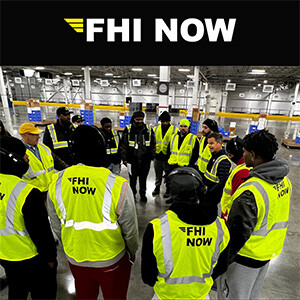
In any market, your supply chain can make or break your ability to compete well. Don't leave that to chance. We can help you create a stronger operation, so you never fall behind the competition.
Stop worrying about labor challenges and start enjoying a safe, lean, and rock-solid supply chain.
(800) 849-3132 | © FHI. All rights reserved.