

As supply chains grow more complex and customer expectations rise, more companies are exploring 3PL warehouse and distribution services to support growth, control costs, and improve execution.
But for many operations leaders, the real challenge isn’t finding a 3PL — it’s understanding how these services actually work, what problems they solve, and where gaps still exist.
This question-based guide answers the most common — and most important — questions companies ask when evaluating 3PL warehouse and distribution services, and explains how managed labor providers like FHI fit into modern distribution strategies.
3PL (third-party logistics) warehouse and distribution services refer to outsourced solutions that manage part or all of a company’s warehousing and distribution operations.
These services often include:
In short, a 3PL provides the infrastructure, systems, and operational support required to move goods from suppliers to customers.
While offerings vary by provider, most 3PL warehouse and distribution services include:
Some companies partner with a single 3PL for all services, while others use a hybrid model, combining a 3PL facility with specialized partners like managed labor providers to improve execution.
Typically, a company:
However, performance depends heavily on labor execution — which is why many companies supplement 3PL relationships with managed labor partners focused on productivity, safety, and consistency.
Companies often turn to 3PL warehouse and distribution services when they experience:
For some businesses, a full 3PL is the right answer.
For others, the real issue isn’t space — it’s labor execution, where managed labor becomes the better first step.
3PL warehouse and distribution services help address:
However, they don’t automatically solve productivity, labor stability, or leadership challenges — which is where many operations struggle even after outsourcing.
This is one of the most misunderstood distinctions.
| 3PL Provider | Managed Labor Provider |
|---|---|
| Provides space, systems, and infrastructure | Focuses on labor execution |
| Often asset-based | People and performance-based |
| Long-term contracts | Flexible, scalable models |
| Manages the warehouse | Manages the workforce |
| Broad service scope | Deep execution expertise |
Many high-performing operations use both:
A 3PL for space and systems
A managed labor provider like FHI to ensure labor performance inside the warehouse
Cost-per-case is influenced by:
While a 3PL may reduce fixed costs, poor labor execution can still drive CPC up.
Managed labor helps stabilize cost-per-case by:
Most 3PLs:
However, during peaks or labor shortages, execution can suffer.
This is why many 3PLs partner with managed labor providers to:
FHI frequently operates inside 3PL environments to support labor execution without disrupting existing systems.
During peak seasons, 3PLs provide:
But peak success still depends on:
Managed labor enhances peak execution by:
Common risks include:
These risks are minimized when companies:
Control comes from:
Managed labor providers like FHI add another layer of control by:
Yes — and it’s increasingly common.
Managed labor can:
For many companies, this hybrid model delivers the best balance of flexibility, control, and performance.
Key evaluation criteria include:
It depends on the core problem:
FHI is often engaged when companies realize:
“We don’t need a new warehouse — we need better execution in the one we have.”
FHI supports 3PL and shipper operations by:
FHI becomes part of the operating model, not just a staffing layer.
3PL warehouse and distribution services are a powerful tool — but they aren’t a silver bullet.
Performance still depends on:
The most successful companies combine 3PL infrastructure with managed labor expertise to create scalable, resilient distribution operations.
That’s where execution meets strategy — and where performance becomes predictable.
3PL warehouse and distribution services are used by companies that need scalable warehousing, fulfillment, and distribution support without owning or operating their own facilities. These services help businesses manage inventory, fulfill orders, and meet customer service requirements more efficiently.
Yes, most 3PL warehouse and distribution services include some form of labor management. However, the level of execution, productivity control, and leadership presence varies by provider. Many companies partner with managed labor providers like FHI to strengthen labor execution inside 3PL environments.
Companies that benefit most include:
These companies often experience volume volatility that is difficult to manage with fixed internal labor models.
3PL fulfillment services provide warehouse space, systems, and operational infrastructure.
Managed labor providers focus specifically on workforce execution, including:
Many operations use both together to achieve better results.
Yes. Managed labor providers frequently operate inside 3PL warehouses to:
This hybrid approach allows companies to retain their 3PL relationship while improving execution.
3PL services can reduce fixed costs, but cost-per-case is still heavily influenced by:
Managed labor helps control these variables, making CPC more predictable and sustainable.
Most 3PLs offer flexibility during peak seasons, but execution quality depends on labor readiness and leadership presence. Managed labor enhances peak performance by providing trained teams and on-site leadership to maintain standards during surges.
Common risks include:
These risks are reduced when companies maintain strong performance metrics and use managed labor to control execution.
Control is maintained through:
Managed labor providers add an additional layer of control by being embedded directly in daily operations.
Companies should consider managed labor when they experience:
Managed labor is often introduced when the warehouse space works — but execution does not.
Yes. Managed labor is designed to integrate with existing teams and systems. Providers like FHI work collaboratively with 3PL leadership to support inbound, outbound, fulfillment, and returns without disrupting operations.
It depends on the core challenge:
Many companies find the hybrid approach delivers the best balance of flexibility, control, and performance.
FHI supports 3PL environments by:
FHI becomes part of the operating model, not just a staffing layer.
👇📅 We're here to help. There's no pitch - just a conversation. 📅👇
If you need dependable support to reinforce your team and get you back on track, FHI NOW can help.

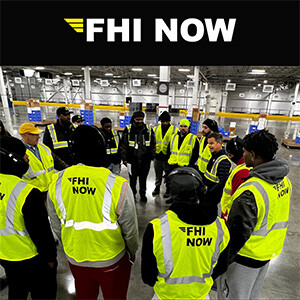
In any market, your supply chain can make or break your ability to compete well. Don't leave that to chance. We can help you create a stronger operation, so you never fall behind the competition.
Stop worrying about labor challenges and start enjoying a safe, lean, and rock-solid supply chain.
(800) 849-3132 | © FHI. All rights reserved.