
INTRODUCTION
A recent story in the Wall Street Journal trumpeted: “The job market doesn’t get much better than this. Unemployment recently touched its lowest level in 49 years (3.7%). Workers are so scarce that, in many parts of the country, low- skill jobs are being handed out to pretty much anyone willing to take them – and high-skilled workers are in even shorter supply.”
With unrelenting demand, companies are being forced to look at non-traditional methods and sources to find capable workers.
Warehouse and DC operations around the country are not immune. The shortage of workers not only impacts their own productivity, but also reverberates throughout the supply chain.
So in February 2019, SCRC faculty and staff convened a group of supply chain executives for a one-day workshop to discuss a spectrum of issues associated with the current state of this challenging job market within warehouse and DC operations.
Companies like Advanced Auto Parts, John Deere, Hanes Brands, UPS, FHI, Lenovo, GSK, Altria, and UNC Healthcare were eager to share what they were experiencing.
What follows is the outcome of that conversation. This paper outlines common challenges and impacts, along with potential non-traditional solutions.
CHALLENGES
Current DC Labor Landscape
The fallout could not be much worse for the logistics industry. The shortage of workers has hit the trucking and logistics industry particularly hard. Freight rates are on the rise, and there are signs that the shortage are unlikely to abate.
Many participants noted that when Amazon raised their warehouse rates to $15 an hour, many of the companies were already paying more than this, and the working conditions were often better than those encountered at Amazon.
Significant Challenges
It’s true that many industries are struggling to attract workers. It is even more true for work categories perceived to be unappealing and offer no opportunity for advancement, like warehouse positions. There are a number of contributing key factors.
Aging Workforce
The stability of a mature workforce is nearing an end as workers 50-60 begin to age out. Taking years of acquired skills and training with them. What was once a category with low turnover, is now threatened with decreased productivity and stability.
The Amazon Effect
Amazon’s cache and promise of higher wages has put pressure on the industry. Even though many employers already had competitive wages in place, the allure of working for Amazon and other tech companies is powerful and real.
Many young hires are seeking quicker gratification and are leaving when they don’t see a plan ahead.
Attracting/Retaining Millennials
Many young hires are seeking quicker gratification and are leaving when they don’t see a plan ahead. HR and DC managers who have been working for a long time in the warehouse have a difficult time adapting to a new reality. A reality that forces managers to use newer methods of recruiting. A reality where workers demand more flexibility, like varying start times for shifts, as family obligations and lifestyles are part of the equation. And this is having an effect across all generations, as the desire for a greater work/life balance is viewed as a real possibility.
Intelligent Automation
While automation may be able to help solve some labor issues down the road, it isn’t a plug and play solution. There are costs and constraints that limit, or delay implementation:
- The need for upgraded facilities suited for some level of automation
- Upgraded data/software that enables accurate real-time management and tracking.
- The on-going threat/cost of downtime associated with new technology.
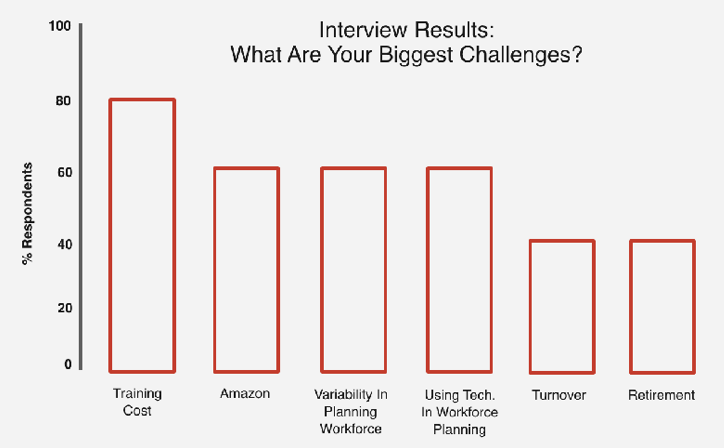
As this chart suggests, when asked, warehouse and DC managers see any number of problems that threaten their ability to maintain efficient operations.
IMPACT
Supply Chain Leaders See a Direct and Significant Impact
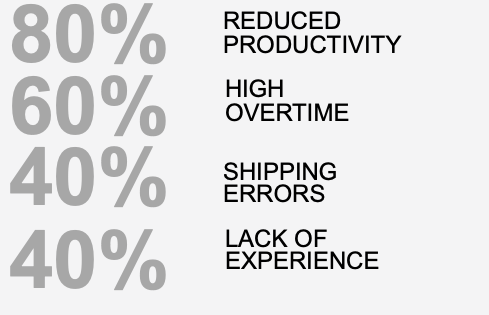
Executives have identified four key areas of impact caused by the challenges they face day- to-day within their operations. Most significant is Reduced Productivity as experienced by 80%. And while significant to the DC operation, the impact is felt in the overall supply chain process through a lack of efficiency and effectiveness. The effect goes beyond just fulfilling customer orders.
What They Had To Say
“Humans make mistakes, and we can deal with that during the early training of people. But the biggest issue that affects us is Overtime. They don’t like mandatory Saturdays. If you do too much of that, they will go elsewhere.”
“We typically see 20-40% turnover, which impacts productivity, customer service, overtime, and increased training costs.”
“We can’t teach all the things you need to know to work in an FDA controlled facility where there are drugs being shipped. Training people to learn all of these details takes a lot of time, and when they leave, that really hurts us.”
“We really need people who can be consistent, and when we lose folks to Amazon, we find that people who can work with the technology requires a long time for them to do so. This leads to a big hit on making our numbers.’’
Unforeseen Consequences
Virtually every company’s supply chain has been affected in some fashion by the workforce shortage. Yet there is another consequence born of this same issue. Today, it has increasingly become everyone’s role to recruit, train and retain workers. While somewhat hidden from the balance sheet, this shift of focus has a compounding effect on productivity within the warehouse itself.

The ability for a warehouse manager to maintain efficient operations while short-staffed, is a challenge. Add the requirement of HR-related activities like interviews and training, job fairs and open houses, the amount of time and energy required places undo pressure into an already stressful situation.
STRATEGY
Shifting Models
To address the worker shortage, organizations are exploring many new types of technologies and hiring models, to make sure that they spend the right amount of time. The goal? To the extent possible, make sure their strategies are aligned to compete for today’s workers. The built-in assumption to labor-intensive operations is that “low cost wins.” But in a competitive market the symptoms of high turnover, untrained workers and absenteeism inflict costs to the operation.
The quality of the associate is the single most
important component of evaluating such services.
Interviews showed that there was overwhelming agreement that the quality of the associate is the single most important component of evaluating such services, followed by the value of the service, meeting FTE targets, reducing Total Cost of Ownership, reducing turnover, and improving inventory accuracy and SLA’s. The benefit of a reliable and trained workforce at a reasonable cost, may result in an overall reduction in operational cost when viewed beyond a line item cost.
The more successful HR teams have built a deep team that evaluates the labor pool they offer, to ensure they work best in certain situations. Others noted that taking extra care to get good workers coming in on the front end is critical to ensuring retention. Many are also exploring new hiring policies, new technologies, and different screening approaches to ensure they get the right people. They are also experimenting with new work policies.
Getting It Right
Every organization must find their ideal solution. And it starts by evaluating your practices and aligning them with an ever-changing labor environment in three key areas.
- Hiring Practices
Survey respondents overwhelmingly emphasized how important it is to get the right quality of associate, and to pre-screen up front to find them. The question of “what are the characteristics of a quality associate was asked? What is the right type of person, who has the right fit, and where do you find the individuals?”
“What are the characteristics of a quality associate?”
“We have two ladies who really know what they are looking for when they interview people. It is almost like they have a sixth sense, and they know what will make for a good worker. We don’t know exactly how they do it – maybe we should study them and build an AI tool to capture what they are doing!”
“We are testing a technology called Outmatch, that uses behavioral questions or assessments to determine the best fit. The app allows you to create a profile for every job we have for the company (e.g. order picker, truck driver), and then create a survey that applicants can complete.”
“It is critical to invest in HR resources that are able to find the right person. This means hiring people in HR that really know how to interview and find the best people.”
“We like to interview potential candidates during a shift, which starts at 4 AM. If they show up at 3:30, we know they are prompt. We also check to see if they can keep up with us when we walk the floor. We would prefer that candidates speak up and tell us they are not interested up front, as it saves us problems later.”
- Flexibility
A key to creating a reliable workforce may not be through increasing wages but offering a new benefit to workers: FLEXIBILITY.
“We need to break the culture that “we are different and it won’t work here”…. We are incented to be silo’d and have no metrics for change.”
“We have massive surges that occur with little advance notice and need to fill the gaps in labor with little advance notice. Our current temp models cannot address this. How do we create a truly “variable” labor force on demand?”
“We are starting to pilot these technologies. We think the target market will be uneducated Millennials, who are looking for a growth position, and must manage their own costs. These individuals want a job that will allow them to adjust their schedule. We think that has potential, so long as we are able to keep this to a fixed number of times per month.”
Survey data by Intuit suggests that 72% of contingent workers choose to remain contingent, and that only 42% are contingent because they feel they have to. There is clearly a trend going on which is being enabled by the “gig” economy and the enabling technology allowing people the opportunity to work how and when they want to. Flexibility may also mean adapting to the nature of the employees themselves. Questioning barriers to hiring as appropriate within each organization.
“There are a number of potential constraints to consider. For instance, liability issues will require drug testing before they can work, as well as OCEA compliance. For companies like UPS, having DOT compliance is key, and random drug tests are the norm to pass DOT requirements.
- Creating Valuable Associates
There is a lot of complexity within an operation. And the same is true of the workforce population. No one size solution fits all. Understanding and adapting to their needs and values can go a long way towards hiring and retention.
“We have debated putting phone charging islands in the break rooms, or free Wi-Fi. Perhaps we could offer cell phone plans, which some may view as more valuable than a 50-cent raise. We need to come to terms with how we are going to differentiate ourselves as an employer, compared to every other DC you walk into.”
“There are certain individuals who are experts in certain SOP’s. We need to have the flexibility to move the right people to different locations for these cases, and we are happy to move them to a hotel for a period of time, to train workers in a location on how to do both processes.”
“Hiring two family members like a husband and wife and working to accommodate their schedules for childcare or care of older family members has paid for itself many times over in terms of retention. Helping them with their personal schedules is a big deal for these workers.”
Solution
Choose The Best Path: Alternatives for Managing Labor Through Outsourcing
A number of new models are emerging to help DC and warehouse managers run their operation. The goal is to eliminate problems associated with the constant churn of finding, training, managing and retaining new workers. Ensuring that people actually show up for work.

Outsourcing is growing in acceptance because it is the core competency of third party providers.
The following pages outline the two models most- employed today: the Contingency Labor Model and the Managed Workforce Model.
Contingency Labor Model
- This solution works well for companies faced with demanding manufacturing cycles, undependable labor pools, shortages in seasonal labor, or the inability to operate their facilities at full potential. It’s flexible in nature and can be implemented on a contractual, project-based, or seasonal basis.

- Meets needs such as rapid company growth, major events or crisis situations that threaten to harm operations, seasonal production increases, new facility start-ups, facility shutdowns, facility relocations. This approach is useful when there is high variability in demand, and there needs to be people who show up when time is not on their side.
- This model works well when the facility requires a highly trained and agile workforce. This approach can help facilities to reduce the hassles of recruiting and retaining high demand labor.
- The model also promotes a flexible price structure designed to deliver predictable costs – built around an organization’s specific needs and expectations.
Executives noted that this model was appealing for certain geographies. For example, in California, the facility pays based on contractual rates and manages spikes and valleys through a piece rate based on every piece picked. “We know what we will pay based on what we sell, and there is a fixed rate.” This is the essence of a true “fixed variable” rate, which may cost more, but will likely yield an improved total cost.
“We know what we will pay based on what we sell, and there is a fixed rate.”
This company notes that they are running this on a 3-5-year pilot and will assess at the end of that period. A risk with this model is that there is a fixed cost, which is not guaranteed, and there is general agreement that the rate may be adjusted in the event of a major drop in sales. In tough labor markets such as Los Angeles, using such an “overflow” model on a transaction basis may makes sense. A variable rate can also be used to unload trucks, pick parts, or any other activity.
Managed Workforce Model
- This model is a high-performance labor solution, offering flexible pricing structures designed to deliver predictable costs.
- An on-site management team working for the outsource provider interacts with the organization’s management to prioritize objectives and achieve efficiencies.
- The goal is to reduce costs and inefficiencies associated with turnover, training, retraining, etc, and to handle all administrative duties associated with hourly workers, thereby simplifying internal processes and eliminating workers comp risks.
- Some managed workforce solutions can focus on opportunities to drive efficiencies, increase throughput, eliminate waste and avoid co- employment.
- Some organizations consider this model when they decide to strategically focus on their core business, and they will outsource specific work cells or the majority of the operation to a managed workforce expert.
With a managed workforce model, the provider owns the SOP’s, and it becomes a fully outsourced model. Defined cost and productivity SLA’s are defined, and this has proven to be successful with a complex product portfolio situation where flexibility and being nimble is key.
SUMMARY/INSIGHTS
The challenges of the current labor market for warehouse, DC workers, and truck drivers is not going away. In fact, labor shortages are likely going to remain the norm for at least 2019 and likely a good part of 2020, as the economy strengthens. This is a good news/bad news situation.
Recent articles have recognized that new approaches are needed, such as the use of on- the-job apprenticeships programs that equip workers with the skills necessary for jobs in professional service roles.
There is also the potential to create more predictive modeling approaches, to better understand when and where people will leave, and uncover patterns for retaining workers to stay in their jobs longer.
The algorithm has predicted with 90% accuracy the
personnel that have since left the company.
For instance, a team at Bechtel developed a model that could predict employee retention outcomes based on advanced algorithms, using 70-80 features sets in the database.
They were able to identify the costs to retain an employee vs. the costs to replace the employee. Through the predictive model they were able to act early to retain the high value talent.
In six months, they were able to prove out the value of the predictive model, which predicted a figure that could be saved by the company. The algorithm has predicted with 90% accuracy employee attrition.
We believe similar models could be developed for warehouse and DC staff.
It may also be worthwhile exploring outsourced labor solutions, to work with companies that specialize in workforce recruiting and retention strategies. Two primary options have a high potential, including contingent labor strategies for peaks and valleys, as well as managed workforce solutions, that involve on-site management of a full-time workforce.
If anything, we have come to a better understanding of how the status quo is rapidly shifting across the board. Companies are in search of best practices, recognizing that a “go it alone” approach may no longer be viable.
INDUSTRY ENGAGEMENT
Supply Chain Partnerships in Action
Our industry partnerships are simple: Faculty lead a team of supply chain management students to research, define and solve supply chain problems. The partnership team makes executable recommendations to provide solutions to real-world supply chain problems. These proposals result in real returns when implemented, ultimately advancing the supply chain industry and positioning both students and businesses for success. Think reduced cost, enhanced profits and increased efficiency.
**NC State College of Management